ISBA: Summary of the context and overall objectives of the project
The project ISBA (Insulation Solutions Based on Aerogels), funded under the Horizon 2020 framework, Europe’s leading research groups develop aerogel-based thermal insulation solutions for use cases ranging from satellites to launch vehicles to re-entry vehicles that are presented by the end users Thales Alenia Space and Ariane Group. The applications are divided into two categories: low- to moderate-temperature applications and high-temperature applications. Aerogels are extremely lightweight nanoporous materials with porosities up to 99.98 % resulting in very low bulk densities, thermal conductivities and acoustic velocities.
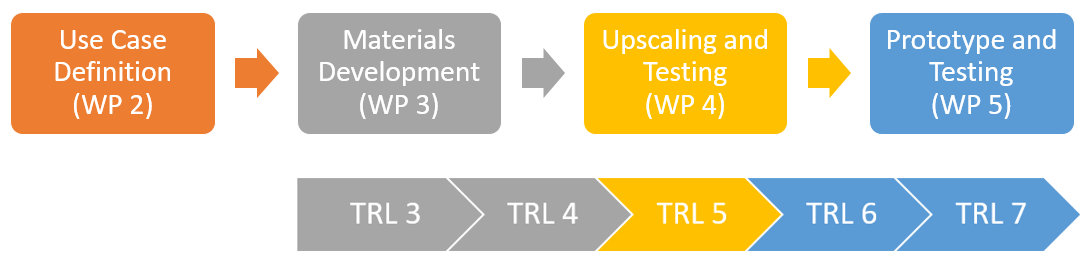
The first objective, which was succesfully achieved, was to identify and define the use cases. These were driven by the end-users, Ariane Group SAS, Ariane Group GmbH, Thales Alenian Space France and Air Liquide. Based on the defined use cases, the aerogel developers were tasked with the ongoing development of inorganic and hybrid aerogels as well as carbon xerogels and polyimide aerogels for cryogenic, moderate, and high temperature space applications. The aerogel developers include the German Aerospace Center, CAE Zero Carbon, Tecnalia, University of Debrecen, and Keey Aerogel. To keep the aerogels intact, enveloping technologies were to be developed and tested by Hutchinson. In this period, the dissemination and exploitation plan of the results from the project ISBA were also to be prepared.
Novel solutions based on inorganic and hybrid aerogels and aerogel composites, as well as polyimide-based alternatives to multi-layer-insulations (MLIs) will be developed for low- to moderate-temperature applications, while solutions based on carbon aerogels as well as other hybrid aerogel composites will be developed for high- temperature applications.
GENERAL OBJECTIVES:
- Develop aerogel/xerogel-based solutions for cryogenic, moderate and high temperature space applications
- Implement additive manufacturing technologies specifically for aerogels in space applications.
- Develop coating-technologies on aerogels/xerogels for operating in space environments.
- Improve cleanliness of aerogels by developing enveloping technologies tailored for aerogels.
- Enhance industrial competitiveness of aerogel/xerogel solutions in space.
- Present EU-efficient alternatives to the current MLI solutions, thus reducing dependency on US Technologies.
Images: DLR, CC BY-NC-ND 3.0
Work performed from the beginning of the project to the end of the period covered by the report and main results achieved so far
The end users identified and defined four use cases. Based on these, relevant bench marks and material requirements were set up and a technology qualification plan was prepared. Critical dependencies were identified. State-of-the-art study on aerogels and enevloping technologies relevant to the project was prepared. Aerogel/xerogel-based solutions that meet the demands and requirements of the end users are currently being developed. The project find itself currently in the materials development phase. Based on the first results, end users have already identified aerogel solutions that show promising results. The eneveloping technologies have been successfully developed and have shown be capable of enveloping proposed aerogel solutions.
Progress beyond the state of the art and expected potential impact (including the socio-economic impact and the wider societal implications of the project so far)
Since the materials are currently under development, the final results and their status in relevance to the state-of-the-art will be described in the next reporting period.